
Archive for the ‘Uncategorized’ Category

Finally in the starting blocks!

Monday, December 1st, 2008

Only a few weeks until launch of the version 1.0!

Only a few weeks until launch!

You can find more details here on our blog!

Ajax or the new interaction of web applications

Friday, November 7th, 2008

New programming techniques allow of individual data exchange with the server:

  • GoogleMail reports without reload when new messages have arrived.
  • Writely, the online word processing programme, opens contact menus after right click.
  • Google Maps zooms maps without resending the entire request to the server.
  • The web is more and more turning into an application, offering look & feel of programmes locally installed on the PC.
  • The secret is the new technology called Ajax.
  • Ajax stands for “Asynchronous JavaScript and XML”.
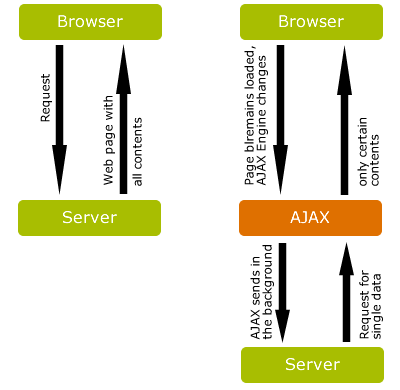
  • The combination of these two techniques allows the exchange of only specifically requested data between browser and server.
  • Ajax provides for new contents on the website without having to completely reload it.
  • The traditional web organisation in sites is taken over by new web applications as fast as desktop software.
  • In addition, Ajax enables the mixing up of different web offers since data can derive from diverse sources.
The AJAX principle
The AJAX principle (According to O’Reilly: Web 2.0 for Participation).

(According to O’Reilly: Web 2.0 for Participation)
From Desktop to Webtop

Wednesday, October 22nd, 2008

Applications can be run on the web, thus being accessible from anywhere. The programmes are installed on servers; there is no need for free memory capacity on one’s own computer, software can be further developed on a more rapid pace:

  • The boundaries between PC and web applications are blurring.
  • More and more software is being directly transferred to the web.
  • The freemail service GoogleMail offers better functions than firmly installed programmes such as Outlook.
  • Online word processing programs are accessible from anywhere.
  • Cooperation of users.
  • The web turns from a collection of websites into a platform.
  • Applications can be run on the web.
  • Applications are therefore accessible from everywhere.
  • Rhe programmes are installed on servers.
  • There is no need for fixed disk capacity.
  • Software can be further developed on a more rapid pace.
  • The user does not have to care about software updates.
  • Web contents are more and more being retrieved by mobile devices such as mobile phones, MP3-players and pocket PCs.
Google Mail and Google Calendar
Google Mail and Google Calendar.
Google Blog Search and Google Docs
Google Blog Search and Google Docs.

Google-services (mail, calendar, text, tables, Google Maps, blogs, bookmarks):
http://www.googlewatchblog.de/google-dienste/

Yahoo! 360° platform:
http://www.yahoo.com/

Windows Live
http://ideas.live.com/
http://labs.live.com/

(According to O’Reilly: Web 2.0 for Participation)
Open interfaces allow for the linking of offers

Friday, October 3rd, 2008

In order to handle software regardless of device boundaries, it is essential to have open interfaces:

  • Web 2.0 is open.
  • Most applications are based on Open Source software.
  • By using open interfaces (APIs) offers and data can be combined with each other.
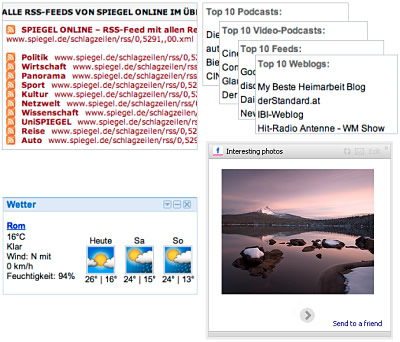
  • RSS Feeds and Widgets allow for the integration of contents on special sites.
  • Standards are given and are constantly being further developed by the World Wide Web Consortium.
Open interfaces combine different offers
Open interfaces combine different offers.

(According to O’Reilly: Web 2.0 for Participation)

End of software cycles (perpetual beta)

Friday, September 19th, 2008

While for computer programmes beta versions are always recognizable as test versions which need further development, web applications can be constantly up-dated – in other words, on web 2.0 everything remains “beta”:

  • Devices and applications keep connecting themselves to the internet.
  • Internet applications are not software artefacts anymore but they become permanent services.
  • New features are permanently being introduced, becoming part of the everyday “user experience”.
  • Users become real time testers, their behaviour informs about the quality of the product update.
  • Shorter “time to market”.
  • Reduced risk.
  • Closer bond with the user.
  • Real time data for taking quantifiable decisions.
"Release early and release often"
“Release early and release often”.
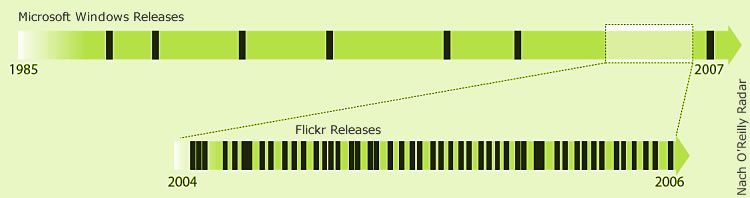
Short software cycles are the critical factor of success on Web 2.0
Short software cycles are the critical factor of success on Web 2.0.
Comparison of the Release Histories of Microsoft Windows and Flickrr
Comparison of the Release Histories of Microsoft Windows and Flickr.

(According to O’Reilly: Web 2.0 for Participation)